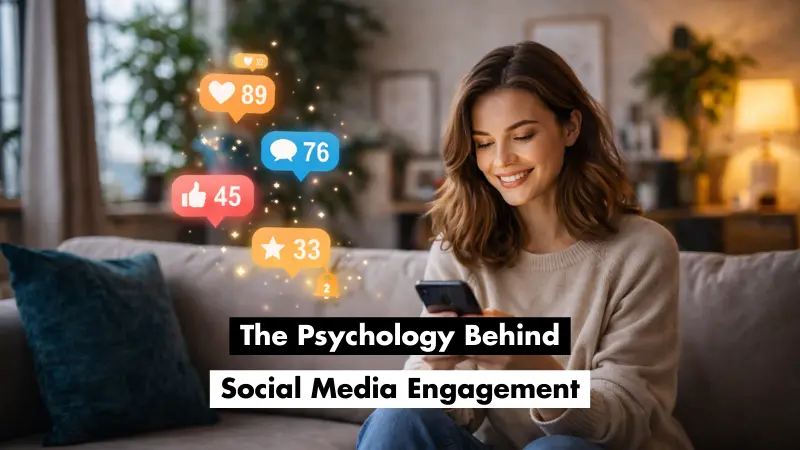
Social media engagement is rarely about luck. People like, comment, save, and share content because it triggers a psychological response— something that feels relevant, rewarding, or identity-aligned in the moment. Understanding these behavioral triggers helps creators and brands design content that earns attention consistently.
In this guide, the smm.ist team explains the psychology behind engagement and shares practical ways to apply these principles across platforms.
Outline
- Attention Is a Filter, Not a Resource
- Emotion Drives Action
- Identity and Belonging: Why People Engage Publicly
- Social Proof and the Bandwagon Effect
- Friction Reduction: Making Engagement Easy
- Reward Loops and Habit Formation
- Practical Ways to Apply Engagement Psychology
- Frequently Asked Questions
Attention Is a Filter, Not a Resource
People don’t scroll to “consume content.” They scroll to filter it. Every post is evaluated instantly: Is this for me? If your message doesn’t communicate relevance fast, it gets ignored—even if the content is high quality.
- Relevance: Does it match a current need, curiosity, or emotion?
- Clarity: Can the viewer understand the value in one glance?
- Trust: Does it feel credible, familiar, or consistent with past posts?
Emotion Drives Action
Engagement is an action, and action is emotional. Content that triggers emotion creates momentum: curiosity keeps people reading, validation makes them react, and surprise makes them share.
- Curiosity: “Most creators miss this one detail…”
- Relief: “If your reach dropped, this might explain why.”
- Inspiration: “Here’s a simple system that improved results.”
- Contrast: “What people think works vs what actually works.”
Identity and Belonging: Why People Engage Publicly
People comment and share to signal identity. Engagement is a public behavior—often a way to say “this is who I am” or “this is what I stand for.” That’s why content that speaks to a specific group tends to outperform generic content.
- Identity hooks: “If you’re a beginner creator…”
- Community language: Use phrases and terms your audience uses.
- Shared struggles: “Everyone hits this plateau—here’s how to break it.”
Social Proof and the Bandwagon Effect
Humans use social proof to decide what matters. Posts that already look “validated” feel safer to engage with. That’s why early momentum can dramatically increase distribution on most platforms.
- Strong early comments create more comments.
- Shares signal “sendable value.”
- Visible participation lowers the psychological barrier to join in.
Friction Reduction: Making Engagement Easy
Even interested people won’t engage if it feels like effort. Reducing friction is one of the most practical engagement strategies. Simple structure consistently beats complex writing.
- One idea per post: Avoid mixing too many topics.
- Skimmable layout: Short paragraphs, bullets, and clear headers.
- Low-effort prompts: “Agree or disagree?” “Which one are you?”
Reward Loops and Habit Formation
Engagement is reinforced by rewards. When your content consistently delivers a satisfying payoff—clarity, entertainment, or practical wins— audiences return and engage more naturally.
- Consistency builds trust: Predictable value reduces hesitation.
- Micro-rewards: Quick tips and checklists make people save.
- Series format: “Part 1 / Part 2” creates anticipation and repeat visits.
Practical Ways to Apply Engagement Psychology
To translate psychology into results, apply these tactics across platforms:
- Write stronger hooks: Start with a problem, outcome, or surprising truth.
- Make it shareable: Use checklists, frameworks, and “sendable” insights.
- Ask one clear question: One CTA per post increases completion and action.
- Repeat winners: Reuse top topics with new angles instead of guessing.
- Optimize early engagement: Reply fast to early comments to extend discussion.
Frequently Asked Questions
Why do people like a post but not comment?
Likes are low-effort and private-feeling, while comments take time and social exposure. Reduce friction by asking simple questions and making participation feel safe and normal.
What’s the best psychological trigger for engagement?
Curiosity and validation are consistently strong. Curiosity earns attention, and validation encourages people to react or comment. The best trigger depends on your audience’s current needs.
How can I increase shares without sounding pushy?
Create content people want to “send”: checklists, quick wins, and timely insights. Use a soft CTA like “Share this with someone who needs it.”
Do controversial posts always perform better?
Not always. Controversy can increase engagement but reduce trust. Constructive contrast works better than aggressive takes, especially if your brand relies on credibility.
Which engagement metrics matter most for long-term growth?
Saves, shares, comment depth, and repeat interactions typically correlate with sustainable growth more than likes alone. Track what drives retention and returning viewers.